
***** Educational Blog Alert *****
The first boat/ship photos are of purse seiners fishing in Prince William Sound. Commercial fishing is regulated so fish are not overfished and, in the case of salmon, are not caught in huge numbers on their way to spawn. The day of our cruise commercial fishermen were allowed to fish for 12 hours - 8:00AM to 8:00PM. The next "opening" is to be announced today. Because pink salmon are heading home to spawn, and because the numbers are down at the hatchery, that opening may not be for a while. Further information on openings-
Various types of commercial fishing are allowed - the following table shows the type of fishing allowed for each category... |
| If the blog has you yearning to visit Alaska for the summer, and you'd like to make some money while you're there, here is a website to help fulfill your dream... http://www.alaska-summer-jobs.com/deckhand_jobs.htm Here's a sample of a job description as a deckhand. It has a good overview of the types of commercial fishing in Alaska. What we saw was purse seiners because pink salmon are running. It the only type of salmon where seine fishing is allowed.
Average crew share: 7-12 percent, $4,000 - $10,000 for two months
Extreme wages: $3,000 day, $20,000+ season (two months)
Read more: http://www.jobmonkey.com/alaska/html/purse_seining.html#ixzz2Zd1vwCRI Follow us:@JobMonkeyNews on Twitter|jobmonkeyjobs on Facebook |

Alaska Summer Jobs
HomeDeckhand Jobs
Commercial Fishing Jobs
Cruise Ship Jobs
Land Tour Jobs
Adventure Travel Jobs
National Parks Jobs
Fishing Lodge Jobs
Construction Jobs
Salmon Canneries & Processing Jobs
Oil Industry Jobs
Alaska Gas Pipeline Jobs
Other Summer Jobs
Alaska Aquaculture Jobs
Domestic Observer Jobs
Alaska Medical Jobs
Alaska Environmental Jobs
Best Alaska Summer Jobs Resources
Newsletter Sign up
Alaska Info
Travel & Tourism InfoWebsites of Interest
Alaska Cruises - Great website for researching Alaska cruise ship vacations.Dude Ranch Jobs - Find out more about working on a dude ranch in North America.
Site Map
Find Jobs In Alaska
Alaska Job ListingsFor Employers - Post Your Alaska Jobs (Only $27!)
Get Alaska
Summer Job Alerts
Via Email
Summer Job Alerts
Via Email
 Sign Up for Job Alerts
Get the latest jobs to your inbox daily. We do the searching for you!
Alaska Summer Fishing Jobs & Deckhand Jobs
 If you desire to work as a deckhand in Alaska during the summer, chances are that you will be working on a salmon fishing boat. Although, there are other fisheries that are in operation during the summer months, salmon is king during the summer in Alaska.
This is particularly true if you are a student and are working in Alaska during your summer break from school. Thousands of college students travel up to Alaska each summer to work in the salmon fisheries.
There are three type of salmon fishing boats that fish in Alaska's waters:Trolling for Salmon
Trolling is different from other types of fishing, in that the quality of the fish is stressed over sheer quantity. Typically, four stainless steel lines, each equipped with 8-12 leaders and a variety of lures, baited hooks and flashers are dragged from a slow moving boat. The lines are periodically reeled in to remove the fish and rebait the hooks. The leaders (18-36 feet of 50-80 lb. test line) must be pulled in by hand. The troller's deckhand will often experience the thrill of fighting a 60-pound king salmon, inch by inch, much like sport fishing.
Once on board the boat, the fish are gutted, then cleaned and iced in the boat hold. In good weather these tasks are quite pleasant, however the the sea can become rough, and sometimes the catch has to be hauled in and cleaned in pounding rain, strong winds and twelve foot swells.
Trolling for salmon is considered an art by most fishermen, as there a number of variables to contend with - types of lures and bait, depth, speed and area to fish, etc. Because of this, it pays to work with an experienced skipper - a skipper with a "sixth" sense. It is this sense which enables him to find fish when no one else can.
Working on a salmon troller is not physically demanding, although you will generally need to work long hours. A crew may work sixteen hour days for three weeks straight, with many skippers fishing every day unless driven in by a severe storm.
Trollers have been doing very well from an earnings stand point. Although the price for salmon is low for some of the other fisheries, Alaska's salmon trollers have seen the prices they get for the salmon remain strong, which puts much more money into the pockets of the skipper and his crew.
Gillnetters for Salmon
Working on a gillnetter is a good way to break into Alaska's salmon fishing industry. The gillnet is long, straight and has floats on the top edge and weights along the bottom. It forms a wall in the water and is designed to entangle fish in the mesh by catching them by the gills. A single "set" may last anywhere from a few minutes to the better part of the day, depending upon weather, the number of fish being caught and the area one is fishing.
Bristol Bay and Southeast Alaska are the two best areas in which to concentrate. In Southeast the gillnet season runs from early July to mid-September. The Department of Fish and Game designates a 2-3 day fishing period "opening", during which most gillnetters fish day and night for the period of the opening. The fishermen then wait a few days until the next opening. This allows the fishermen time to rest and enjoy the site seeing and recreational activities in Alaska.
Purse Seiners
Purse seining is the most productive of the salmon harvesting methods. The technique utilizes a large seine net to encircle migrating schools of salmon. The nets range from 90-250 fathoms (one fathom equals six feet) depending on the regional restrictions. Once the fish are encircled, the bottom of the net is drawn closed using a "purse line" to form a funnel-like shape. the net is then hauled aboard the boat with the aid of a hydraulic power block at the end of the seiner's boom, then the fish are dumped into the boat hold. The whole procedure is called a "set." A good set yields over 3,500 fish, and under ideal conditions, may be completed in as little as 40 minutes.
Purse seiners require a crew of 4-6 people who are compatible and able to work together efficiently as team. Because of the size of the crew, finding a jobs on a purse seiner is easier than on other boats.
Purse seine boats are up to 58 feet in length and many are very modern. Many of them have color TV's, DVD players, saunas and other amenities to make your time off more enjoyable.
If you are interested in finding out more information about working as a deckhand in Alaska, we recommend the following resources:
Alaska Fishing Jobs @ Alaska Job Finder.com
Alaska Fishing Jobs through JobMonkey.com
Making Sets
On purse seiners the greatest part of the workday is given to the repetitive process of making sets. ("Set" is the term given to the process of laying out and retrieving the net, a process that is repeated many times each day.)
Most seining is done very close to shore, where schools of migrating fish appear in the greatest concentrations. While the crew checks the deck and equipment for readiness, the captain studies conditions of tide and current, light, wind and observable fish behavior to determine where he will make his set. At this point in the operation the skiff is attached to the seiner's stern, and the skiffman is at his steering station in the skiff, with the engine running in neutral.
Arriving at his chosen spot, the captain signals the crew to release the skiff. Now released, and pulling one end of the net, the skiff turns and motors into position, usually facing and quite close to the rocky shoreline. The captain drives the seiner away from the skiff, and the quarter mile-long net pays out over the stern.
The Tow
As the last of the net slides off the seiner's stern, the captain slows the boat and begins to tow slowly against the current on his end, holding the net in a generally semi-circular shape.
Purse seine nets are constructed in three main parts: a corkline along the top strung with buoyant floats called “corks”; the webbing (also called the “mesh”) of the net itself below the corkline, and a heavy leadline (a thick, nylon line with chunks of lead woven into it) at the bottom. The corkline floats on the surface of the water, the web hangs down in the water like a fence and the weighted leadline keeps the "fence" hanging more or less straight down in the water.
The tow lasts about twenty minutes, during which time the crew throws any fish remaining on deck into the hold and hoses down the work area to clear it of seaweed and jellyfish. There are usually a few minutes to relax and grab a sandwich or cup of coffee during tows. During the tow, the captain and skiffman are holding the net open so fish can swim into it. At the end of the tow, the captain tells the skiffman, by radio, to "close up." Hearing this, the deckhands and the cook scramble back into their rain gear and gloves so they can "haul gear."
Closing the Net
The skiffman closes the circle of the net by driving alongside the seiner and handing off his end of the net to the deck crew. He then drives out under the towline attached to the seiner. Circling to the other side of the seiner, he attaches another towline to the "big boat," which he will pull on with the skiff to hold the seiner in proper relation to the net as it comes back aboard.
When the net is "closed up," it is hanging like a big circular corral in the water. The fish that swam into the net during the tow are now caught, but they can still escape by diving, since the bottom of the net is floating too, not resting on the bottom.
To prevent their escape, the crew "purses" it closed, using a large winch mounted on the seiner's deck. Visualize a long drawstring closing the bottom of a giant, mesh bag. That's what pursing is. Once underway, it is time for the net to come aboard.
The power block does the heavy lifting in a seine operation, pulling the net out of the water and over the deck. As the net passes through the power block it is then lowered toward the work deck, where two or three crewmembers stack it in a pile.
The Fish
The fish come aboard in the last part of the net, and are emptied either onto the deck or directly into the hold. Hauling gear takes about 15 minutes for most seiners today. An efficient crew on a well-equipped purse seiner can complete 15 to 18 sets per day. (Because it was only a 12 hour opening, and because the fishing boats are quite a long way from Valdez, there are private boats that vacuum the fishing boat's catch and keep them alive in refrigerated sea water holds. They weigh the fishing boats catch for payment from the canneries.)
The Valdez Salmon Hatchery
The Solomon Gulch Hatchery
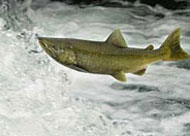 Valdez Fisheries Development Association Inc., operates the Solomon Gulch Salmon Hatchery here in Valdez Alaska. Constructed in 1982, the Solomon Gulch Hatchery is permitted to incubate 230 million Pink Salmon eggs and 2 million Coho salmon eggs annually
VFDA’s primary purpose is to provide salmon for the Common Property which includes commercial, sport and other end users. Each year starting in mid June, the Solomon Gulch hatchery awaits the return of it’s Pink salmon.
An average return for VFDA is about 10 million adults. After harvesting a small percentage of the return for cost recovery, the remainder is harvested primarily by the Commercial purse seine fishermen and the sport fishermen. In addition, VFDA collects approx., 350,000 adults for brood stock.
August is for Coho’s. The annual return of adult Coho to Valdez is between 150,000 and 250,000. This allows the community of Valdez to sponsor the Valdez Silver Salmon Derby with great success. The best time for sport fishing Coho’s is late August through Labor Day.
The Solomon Gulch hatchery is a strong economic engine for the Valdez and Prince William Sound area. Studies have shown that it contributes approx., $110 million annually to the region.
Sales for our Solomon Falls Seafood’s helps to off-set our operating expenses and debt retirement. This allows VFDA to reduce the amount of Pink salmon needed to meet our cost recovery goals leaving more fish for the Common Property.
http://www.alaskadispatch.com/article/are-prince-william-sound-salmon-hatcheries-curse-or-blessing
Here are our purse seiner photos -
Making the set


The skiff and the skiff man.

The tow.

Closed up, pursed and dumping the fish.


A vacuum boat.

One of "The Deadliest Catch" ships

I know it's long, but we thought the fishing was very interesting. Next installment is the good stuff - glaciers, whales, sea lions and otters.

This comment has been removed by the author.
ReplyDeleteThe Meares Glacier Cruise is a popular day trip that departs from Valdez, Alaska, taking visitors through the stunning Prince William Sound. Meares Glacier is notable as one of the few advancing tidewater glaciers in North America, offering an extraordinary opportunity to observe calving events, where chunks of ice break off into the water. Along the way, the cruise provides chances to spot marine wildlife such as whales, sea lions, and porpoises.
ReplyDeleteTo excel in the pharmaceutical representative job search, start by obtaining a relevant degree and networking within the industry. Customize your resume and cover letter, highlighting your product knowledge and communication skills. Research companies thoroughly and consider informational interviews. Stay persistent and informed about industry trends to enhance your chances of securing a position.US postal worker jobs